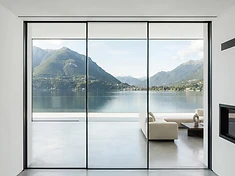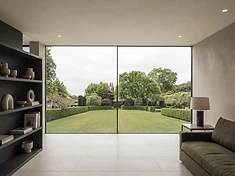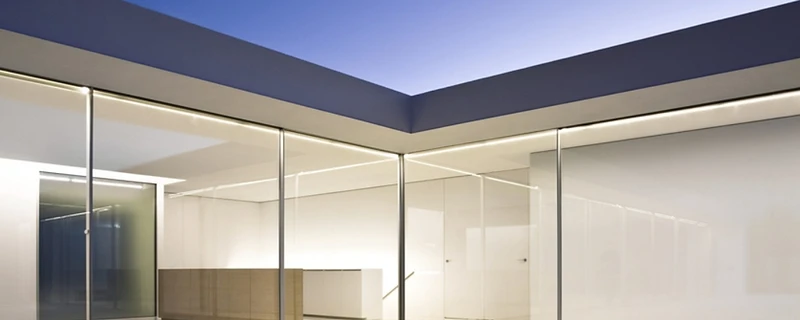
The sightline is the number most often quoted in minimal-frame sliding doors, and the one most often misunderstood. An 18 mm sightline is not 7 mm 'better' than a 25 mm sightline in any simple sense. The figure describes one specific dimension, and the frame you actually see depends on several others.
What the sightline measures
The sightline is the visible width of aluminium at the meeting stile — where two sliding panels overlap, or where a sliding panel meets a fixed one. It is not the outer frame, and it is not the gap between panels. When a system is described as '18 mm sightline', it means the interlock reads as roughly 18 mm of metal from inside the room.
Across the systems we supply, the sightlines run from 18 mm (MFP18 and Vitrocsa 3001) through 20 mm (MFP 20), 22–23 mm (Vitrocsa V56, TH+ and V32) and 25 mm (MFP 25) to 34 mm (Solarlux cero III) and 55 mm (Solarlux Ecoline S and Highline S). Each step changes the amount of glass, but not always in the way you would expect.
The number of panels multiplies the sightline
A single 18 mm interlock in a two-panel door is 18 mm of metal. A four-panel door with three meeting stiles at 18 mm is 54 mm of metal across the opening — more than a single 25 mm interlock would give in a two-panel configuration. This is why the panel area limit matters as much as the sightline: a system that can take a larger panel needs fewer panels, and fewer interlocks, to fill the same opening.
For a wide opening, a 25 mm sightline system that can carry a 16 m² panel may show less total metal than an 18 mm system limited to 6 m² panels, simply because it needs fewer of them. The sightline is a per-stile figure; the visible frame is the per-stile figure times the number of stiles.
Perimeter concealment changes everything
Most of these systems allow the outer frame — the head, jambs and sill — to be concealed into the wall, floor and ceiling so that only the interlock is visible. When that is done well, the difference between an 18 mm and a 25 mm interlock is genuinely the difference the room feels. When it is not done, the outer frame reads too, and the sightline figure flatters the result.
Concealment is a building work, not a door work. It needs the wall built out to receive the frame, the floor set down for the track, and the head structured to take the load. If the opening is being formed at design stage, concealment is usually possible; if the door is being fitted into an existing opening, it may not be.
What the wider sightlines buy
Moving from 18 mm to 34 mm is not a compromise — it is a different engineering choice. The wider interlock on the Solarlux cero III carries triple glazing up to 54 mm, a Uw down to 0.80 W/m²K, RC3 burglar resistance and passive-house certification. The wider frame is part of how that performance is achieved. Similarly, the 55 mm sightline on the Ecoline S and Highline S is what lets the glass line up flush with matching Solarlux bi-folding doors and windows.
The trade-off is honest: an 18–25 mm sightline buys the view; a 34–55 mm sightline buys thermal, sealing and security headroom. Neither is wrong. The question is which the project needs.