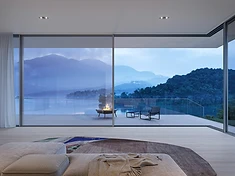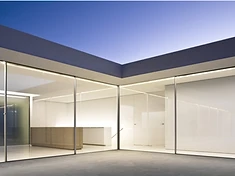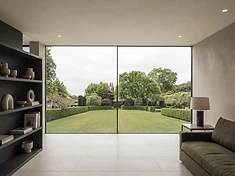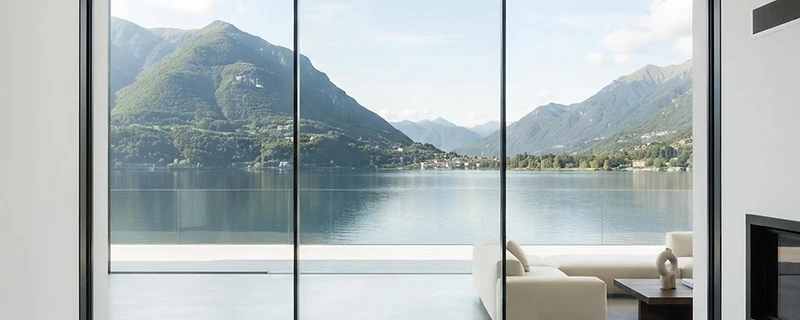
Vitrocsa, Solarlux and MFP approach the minimal-frame sliding door from three different engineering traditions — Swiss, German and Spanish. The systems are not interchangeable, and the differences are not just in the sightline. They differ in how the frame is built, how much glass each panel can carry, how the track is drained and what the tested performance allows.
MFP18 — the slimmest interlock
The MFP18 family (H30, H40 and H50) runs an 18 mm sightline across the range. The H30 takes panels up to 6 m² and 28 mm double glazing; the H40 takes panels up to 18 m² and 6 m tall with 38 mm double glazing; the H50 adds 48 mm triple glazing for a Uw down to 1.05 W/m²K. All three offer a pillarless corner module and a pocket door, and the perimeter frame can be concealed so the interlock is all that reads.
MFP18 is the route when the priority is the slimmest possible interlock and the opening can be formed to receive a concealed frame. The trade-off is that the slimmest interlock carries double glazing on the H30 and H40, and the H50's triple glazing is the most thermally demanding of the three.
MFP 20 and MFP 25 — perimeter-concealed minimalism
MFP 20 runs a 20 mm central junction with a frame that can be concealed around the perimeter, a 90° corner without a mullion, and a pocket system. It is the cost-efficient route to a concealed-frame look, with sashes up to 2,500 × 3,000 mm and 320 kg. MFP 25 widens the interlock to 25 mm but takes panels up to 4 × 4 m, glazing up to 56 mm, and a quad track that stacks four panels to one side. It is built for statement openings and panoramic living spaces.
These systems suit projects where the concealed-frame look matters and the opening is wide rather than tall. The wider interlock is the price of the larger panel and the heavier glazing.
Solarlux — passive-house performance
The Solarlux cero III runs a 34 mm sightline with triple glazing, a Uw down to 0.80 W/m²K, RC3 burglar resistance and passive-house certification — the most thermally and security-demanding option in the range. The Ecoline S and Highline S run a 55 mm sightline but are designed so the glass line aligns flush with matching Solarlux bi-folding doors and windows, which matters when a project mixes sliding panels with bi-folds and fixed glazing.
Solarlux is the route when the project needs certified passive-house performance, the highest security rating, or a sliding door that has to line up with a wider Solarlux facade. The wider sightline is what carries the performance.
Vitrocsa — the largest panels
Vitrocsa's V56 takes panels under 20 m² with 56 mm glazing — the largest single panels in the range — with a 22 mm sightline and frames embedded and concealed in the floor, wall and ceiling. The TH+ takes panels up to 18 m² with 32–44 mm double or triple glazing and a MINERGIE-frame Uw of 0.97 W/m²K. The V32 and 3001 cover standard and hot-climate openings respectively. Vitrocsa does not publish a Uw for every model; where it is not published, we will not state one.
Vitrocsa is the route for the largest single panels and landmark architecture, installed by Swiss-trained teams. The trade-off is that some thermal figures are not published in the same way as Solarlux's, so performance comparisons should be made on the documented values, not assumed.
How to choose between them
The honest summary: MFP18 for the slimmest interlock, MFP 20/25 for concealed-frame minimalism at scale, Solarlux cero III for certified passive-house performance and the highest security, Solarlux Ecoline/Highline S to line up with a Solarlux facade, and Vitrocsa for the largest single panels. None is universally better; each is engineered for a different priority.
The comparison tool on this site sets the published figures side by side, and the system finder will narrow the options to those that meet a given set of priorities. Both are a better starting point than the sightline alone.